

Five Things I Ask Before We Start Any Lesson in Our Homeschool
Because how you show up before the lesson starts is half the lesson.

It was a Tuesday morning. My phone kept going off. I stepped away to check something “real quick.” Twice. Maybe three times.
My boys sat at the table, waiting. I sat half with them and half somewhere else entirely.
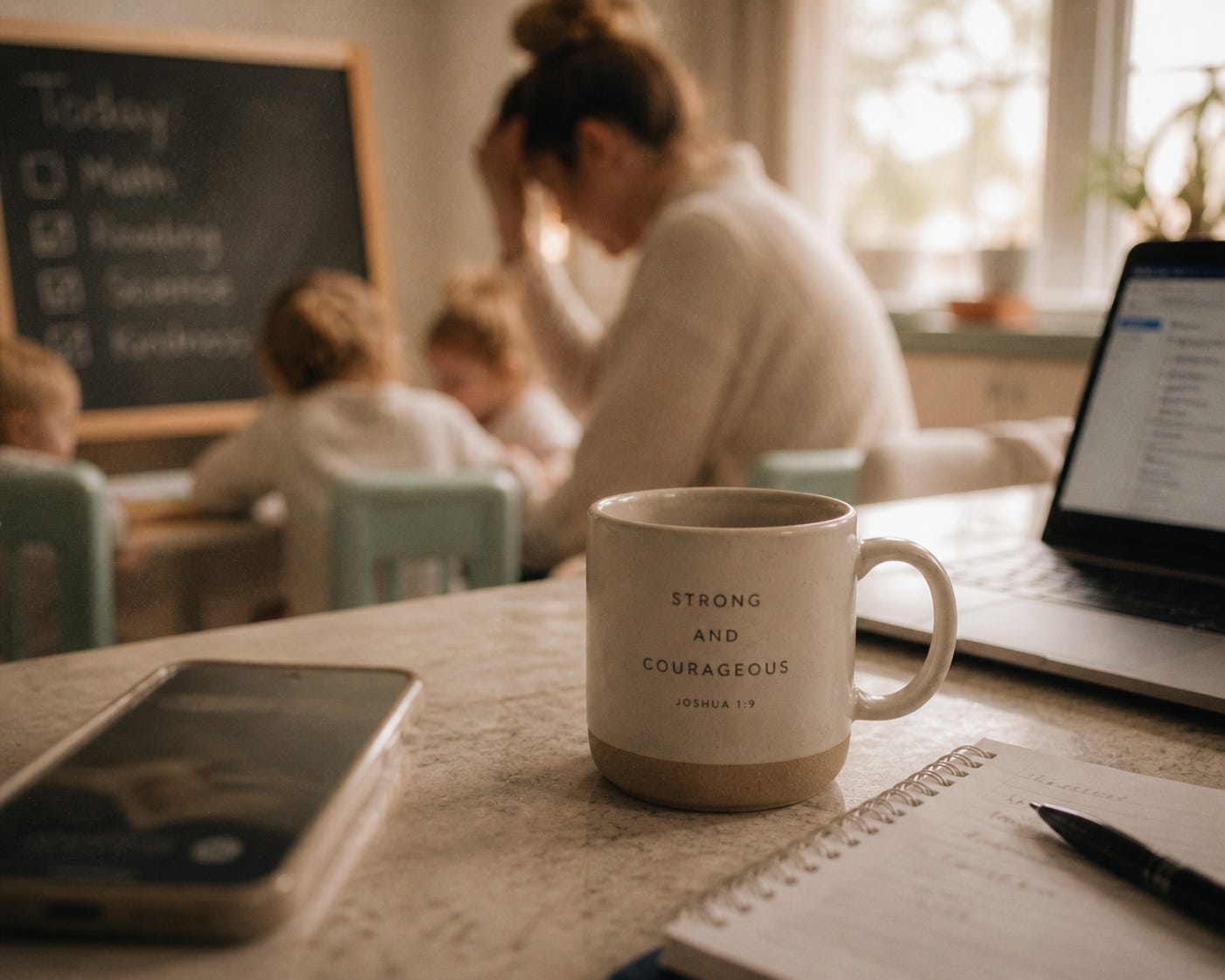
The lesson took twice as long as it should have. Everyone was frustrated. At some point we gave up on the table and ended up on the couch together, which (honestly) was actually kind of lovely. But we got there the hard way. Through the friction and the distraction and the slow unraveling of a morning that didn’t have to go that way.
Here’s what I’ve learned after a decade in the classroom and a few years of homeschooling my own kids: it’s much easier to do one thing well and fully present than several things halfway and under stress.
And almost everything about how a lesson goes is decided before the lesson starts.
So now, before we open a single book or workbook, I ask myself five things.
1. Have I actually arrived?
I have a work block most mornings before my boys are up. It’s one of the things that makes our school day possible, but it also means that when school starts, I have to make a conscious choice to actually leave work.
Some days I do. Some days work follows me into the kitchen whether I invited it or not: an email I’m still composing in my head, a task sitting unfinished, a Voxer message I’m half-waiting for.
A child always knows when you’re halfway somewhere else. They feel it before you’ve said a word.
So the first question isn’t about them. It’s about me, as the administrator and teacher of our homeschool. Have I actually arrived? Phone down. Laptop closed. Sixty seconds (sometimes less) to consciously close one chapter and open another.
You cannot be fully present for your children if part of you is still at your desk. The transition doesn’t happen automatically. It has to be chosen.
Some days I still struggle with this.
2. Have I handed this to Jesus?
I’ll be honest with you: this one is inconsistent for me. And that inconsistency is kind of the point.
Some mornings I pray before school with intention, a real eyes-open acknowledgment that I cannot do this well on my own. Other mornings I forget entirely, or I say something quick and rote and move on, and I feel the difference by 9:30.
And, believe me, when I notice this difference, we stop, drop everything, and fold our hands to get back on track.
There’s a meaningful gap between Lord, be with us today said out of habit and I cannot nourish these children’s minds without You, help me said out of actual dependence. The first is a warm-up ritual. The second is a transfer of responsibility.
That’s what I’m going for when I remember to go for it: not asking God to bless what I’m about to do, but asking Him to do it through me. There’s a humility in that posture that changes how I walk into the room where my boys are waiting.
On the mornings I skip it, I usually wish I hadn’t.
I’m working on it—Lord, help me!
3. Have they handled their Bs?
My boys know exactly what this means. We’ve said it enough times that it’s just part of our language now.
Bed made. Breakfast eaten. Hair brushed. Teeth brushed. Bedroom tidied.
Five things. Non-negotiable. And yes, we call them the Bs.
I’m thinking about adding another that has to do with physical movement or heavy lifting, but I’m struggling to come up with a ‘B’ for it—what about ‘Build your muscles’?? Any suggestions? Let me know in the comments, please!
This isn’t arbitrary. A child who sits down to a lesson with an unmade bed and an empty stomach is carrying unfinished business into the work. Their brain knows it even if they can’t articulate it. Their body isn’t regulated. They’re not ready, and you’ll feel that resistance all morning and wonder what’s wrong.
The Bs create the physical and psychological conditions for learning to actually happen. They are, in the most practical sense, the first lesson of the day.
Check them before you open a single book. Every time.
4. What do they need from me today: structure or control?
This is where ten years of early childhood education shows up at my own kitchen table.
Some mornings a child needs you to hold the structure firmly. A clear sequence, defined expectations, and no negotiation on what comes next. That kind of containment actually feels safe to a kid who’s dysregulated or tired or just needs someone to be in charge.
Other mornings, the same child needs a measure of agency. Which subject do we start with? Do you want to work at the table or on the floor? Having some say in the shape of the day gives them something to hold, and they come in more willing because of it.
The mistake is running the same program every morning regardless of what you actually see in front of you.
This is the question that asks you to look at your children before the day begins. Not glance. Look. Who showed up this morning? What do they need? A skilled teacher reads the room before she teaches it, and you are a skilled teacher, even if no one gave you a certificate for this particular classroom. God gave them to you. You know your children best.
5. Do they need to move first?
As stated above, I’m considering adding this as one of the Bs, although it doesn’t seem to be a need every morning. So at the moment, we consider it on a case-by-case basis.
One of my boys (usually the younger one) will sometimes come downstairs already squirrely. Bouncing. Unable to settle. And I have learned (sometimes the hard way) that trying to start a lesson in that state is fighting a current I will not win. No matter how hard I try!
Ten minutes outside. A few laps around the yard. Downstairs with dad if he’s home. Something physical that lets his body finish what it started so his brain can show up for what’s next.
A child who needs to move and is forced to sit will spend the entire lesson fighting you. A child who gets the movement he needs comes back ready to receive. This isn’t permissiveness, it’s wisdom. There’s strong early childhood research on physical movement and cognitive readiness, and you don’t need a teaching degree to observe it in your own kids.
You just have to be willing to delay the lesson by ten minutes to save the next ninety.
The Real Lesson
We ended up on the couch that distracted morning. Eventually. After the friction and the phone and the stopping and starting.
And honestly? Sitting there together, the lesson finally moving, everyone a little softer, it was a good moment. It just cost more than it needed to.
None of these five questions are about curriculum. None of them are about being a perfect teacher or running an efficient homeschool or checking every box before noon.
They’re about showing up. To your children. To your God. To the sacred, ordinary, irreplaceable work of forming little souls in your living room every single day.
That work deserves your full presence. So does the One who called you to it.
If you want to think through what this looks like in your specific homeschool, I have a few spots open for a conversation. Just reply to this post. I’d love to chat with you!
B-Getting “B”uff! 😉 Love your 5 B ideas! Great post, Erin!
Great ideas. So important to start with genuine prayer and a humble spirit as the foundation. I love the Bs and might add a B for Bodywork, or Bouncing on the trampoline?